
From Graham to Buffett: How Value Investing Evolved from Cheap Assets to Durable Businesses
A LongViewValue framework on how value investing evolved from Benjamin Graham’s margin of safety and cheap assets to Warren Buffett and Charlie Munger’s focus on durable businesses — and why different value strategies require different market habitats.

Evolution is not replacement.
Graham and Buffett are not two ranks of intelligence, but two ways of matching price, value, and opportunity.
Value Investing Is Not a Static Formula
Value investing is often misunderstood in two opposite ways.
The first misunderstanding is that value investing simply means buying low P/E, low P/B, net-net stocks, cigar butts, or statistically cheap companies. In this version, the discipline is reduced to a screen: find cheap securities, wait for the valuation gap to close, and repeat.
The second misunderstanding is the mirror image of the first. Modern value investing, in this version, means buying great businesses and holding them forever. Find the next See’s Candies, Coca-Cola, or Apple. Pay up for quality. Let time do the rest.
Both views contain partial truth. Both are also incomplete.
Value investing is not a fixed formula. It is an evolving intellectual discipline organized around one permanent question:
What is the relationship between price, value, and uncertainty?
Benjamin Graham answered that question through measurable cheapness, conservative appraisal, and margin of safety. Warren Buffett first absorbed that discipline and practiced it through cheap assets, statistical bargains, and special situations. Charlie Munger then helped Buffett broaden the meaning of value to include business quality, economic goodwill, owner earnings, capital allocation, and time.
But this evolution did not make Graham obsolete.
The more useful interpretation is that Graham-style investing and Buffett-Munger investing are different ways of sourcing margin of safety. One often begins with price far below measurable asset value. The other begins with a durable business purchased at a rational price. Neither method is universally superior. Each requires a suitable market habitat.
A market filled with companies trading below conservatively estimated net cash or asset value may be fertile ground for Graham-style investing. A market where classic bargains are scarce but high-quality businesses occasionally trade at rational prices may be better suited to the Buffett-Munger approach. A market with neither cheap assets nor rationally priced quality may require patience rather than action.
The mature lesson is not that investors should choose Graham or Buffett.
The mature lesson is that value investing is a toolkit — and every tool works only under the conditions for which it is suited.
In This Report
This framework unfolds through ten ideas.
→ Why Graham’s value investing began as a discipline of protection
→ How Buffett first practiced Graham’s method
→ Why Munger changed the investment time horizon
→ Why Graham-style and Buffett-Munger investing should not be ranked mechanically
→ Why market habitat determines which strategy fits
→ Why cheap assets still require business judgment
→ How a three-layer equity framework combines price, quality, and future value path
→ Why See’s Candies became Buffett’s turning point
→ Why circle of competence has no industry label
→ What this evolution means for LongViewValue’s research framework
Graham: Value Investing as a Discipline of Protection
Benjamin Graham’s value investing was born as a defensive discipline.
It was not designed to identify the most admired companies. It was designed to protect investors from speculation, emotional markets, fragile expectations, and permanent capital loss.
That historical context matters. Graham’s framework emerged from an era shaped by market crashes, speculative excess, inconsistent disclosure, and investors who often confused rising prices with business reality. He saw what happens when market enthusiasm is treated as evidence. He also saw what happens when that enthusiasm collapses.
His response was not to predict the next boom. It was to build a system that could survive the next bust.
Price Is Not Value
The foundation of Graham’s discipline is the distinction between price and value.
Price is what the market offers. Value is what the asset or business is worth under conservative analysis. The investor’s task is to avoid mistaking the quotation for the truth.
This sounds simple. In practice, it is psychologically difficult. Markets are social environments. A rising stock price creates confidence. A falling stock price creates fear. Investors are naturally tempted to infer value from price movement.
Graham’s discipline reverses that habit. The investor must first develop an independent estimate of value. Only then can market price become useful.
The market gives prices every day. It does not give intrinsic value. That must be estimated independently.
Mr. Market as Optionality
Graham’s Mr. Market is one of the most useful behavioral frameworks in investing because it changes the investor’s relationship with the market.
Mr. Market appears each day with an offer. Sometimes he is euphoric and offers to buy at a high price. Sometimes he is depressed and offers to sell at a low price. The crucial point is that the investor has no obligation to transact.
Mr. Market is useful only when the investor has an independent estimate of value. Without that independent estimate, volatility becomes anxiety. With it, volatility becomes optionality.
The investor does not need to predict Mr. Market’s mood. He only needs the discipline to act when the offered price is attractive, and to do nothing when it is not.
Margin of Safety
Margin of safety is Graham’s central operating principle.
It means buying below conservative value. It means creating a buffer against analytical mistakes. It means respecting uncertainty. It means reducing the probability of permanent capital loss.
Most importantly, margin of safety is not an expression of confidence. It is an expression of humility.
Margin of safety is not a declaration that we are right. It is an admission that we may be wrong.
That is why Graham’s framework remains powerful. A system built around the possibility of error is more robust than a system built around conviction. Conviction can be wrong. A margin of safety helps absorb the consequences.
Why Graham Focused on Cheap Assets
Graham’s emphasis on tangible assets, net current assets, liquidation value, and low valuation multiples is sometimes treated as a limitation. That is too dismissive.
Graham focused on measurable assets because they were more observable than long-term forecasts. In uncertain environments, the balance sheet may offer a more concrete basis for analysis than projections about future growth.
This does not mean Graham ignored business quality. It means he preferred evidence that could be conservatively verified. If a company traded below net current asset value, or if liquid assets exceeded market capitalization, the investor could identify a margin of safety without relying on a heroic forecast of future earnings.
In that sense, Graham’s framework was not primitive. It was deliberately conservative.
His enduring contribution can be reduced to three disciplines:
- Do not confuse price with value.
- Demand evidence before acting.
- Require a margin of safety because the future is uncertain.
Graham’s framework was a discipline of survival. And survival is underrated in investing.
Buffett’s Early Years: Graham’s Discipline in Practice
Warren Buffett did not begin as the investor later associated with See’s Candies, Coca-Cola, GEICO, or Apple.
He began as a Graham student.
As a young investor, Buffett was fascinated by stock prices and market activity. He bought his first stock at age 11. His early experience included the classic mistake of selling too soon: buying Cities Service Preferred, watching it fall, selling after a recovery, and then seeing it rise much further.
The lesson was not merely that investors should be patient. The deeper lesson was that price movement alone is an inadequate guide. If underlying value continues to improve, selling after a short-term recovery may be a mistake.
Buffett’s decisive intellectual shift came from reading Graham and later studying under him. Graham gave Buffett a different way to look at securities: not as moving prices, but as fractional interests in assets and businesses that could be appraised.
Buffett’s transformation was not from ignorance to genius. It was from market fascination to business appraisal.
Buffett as a Graham Practitioner
During the partnership years, Buffett’s method was recognizably Grahamian. He was price-disciplined. He looked for mispricing. He was willing to buy unpopular or neglected securities. He studied special situations. He cared about downside protection. He was comfortable acting against consensus.
This period matters because Buffett did not skip Graham. He mastered Graham before expanding beyond Graham.
The partnership years also developed traits that remained central to Buffett’s later investing: independence, patience, respect for downside risk, willingness to say no, and comfort with temporary unpopularity.
Those traits are not limited to cheap-asset investing. They are general requirements for serious value investing in any form.
Buffett Closing the Partnership
Buffett’s decision to close his partnership in 1969 is important because it illustrates a point often missed in abstract debates about investment style.
He did not close because value investing had failed. He closed because he could no longer find enough attractive opportunities. The market habitat had changed. The kind of bargains that had supported the partnership’s earlier success had become scarce.
A strategy can be sound and still lack opportunity when the market habitat changes.
This is a crucial distinction.
A method may be intellectually valid and still have little to do if the market is not offering the inputs it requires. Graham-style investing works best when securities are available below conservatively measurable value. If those securities disappear, the method has not been disproven. The opportunity set has changed.
This insight becomes central to understanding the evolution from Graham to Buffett and Munger.
Munger’s Influence: Quality Changes the Time Horizon
Charlie Munger did not make Buffett abandon value investing.
He helped Buffett broaden the definition of value.
The common description is familiar: Munger pushed Buffett away from buying fair businesses at wonderful prices and toward buying wonderful businesses at fair prices. The phrase is useful, but the deeper change was not merely about quality. It was about time.
When an investor buys a mediocre business cheaply, the return usually depends on market revaluation. The stock must close the gap between price and asset value before the business deteriorates or capital is wasted. Time may not be an ally. In a poor business, time can erode the very margin of safety that made the investment attractive.
When an investor buys a durable business at a rational price, time behaves differently. The business itself can create value while the investor waits. It can raise prices, retain customers, reinvest at high returns, generate cash beyond maintenance needs, and deepen its competitive advantage.
The return no longer depends only on Mr. Market recognizing a mispricing. It can also come from the compounding of business value.
The Limits of Cheapness Alone
A mediocre business may be cheap and still fail to compound.
It may have weak economics, low returns on capital, heavy reinvestment needs, poor management, declining industry structure, or an eroding competitive position. It may look statistically cheap because the market is correctly discounting deterioration.
A cheap business can produce a good one-time return if the valuation gap closes. But it may not be a long-duration compounding machine.
That difference matters. In a cheap-asset investment, the investor often needs the market to recognize value. In a great-business investment, the investor may benefit from the business creating more value over time.
Opportunity Cost
Munger’s contribution also includes opportunity cost.
The relevant question is not only: Is this cheap?
It is also: Compared with what?
A mediocre asset purchased at a large discount may offer a good return if the gap closes quickly. But a durable compounder purchased at a rational price may create more absolute value over a longer period if it can reinvest at high rates.
This does not mean every quality business is superior to every cheap asset. It means the investor must compare opportunity sets, not slogans.
Quality as a Source of Margin of Safety
In Graham’s framework, margin of safety primarily comes from price.
In the Buffett-Munger framework, business quality can also strengthen margin of safety. Durable demand, customer captivity, pricing power, low capital intensity, high returns on incremental capital, and rational capital allocation can make intrinsic value more likely to hold or rise over time.
But this idea is dangerous when misused.
Business quality can strengthen margin of safety, but it cannot excuse overpayment.
A wonderful business purchased at an irrational price can still produce disappointing returns. Quality changes the time horizon, but the price paid still determines the investor’s starting point.
Munger did not make Buffett less value-oriented. He made the meaning of value more complete.
No Universal Hierarchy: Market Habitat Matters
The standard narrative says that Graham-style investing is an early-stage method and Buffett-Munger investing is the more advanced method.
There is some truth in that narrative at the theoretical level. A durable business that can compound capital for decades is generally more powerful than a mediocre asset bought cheaply for a one-time revaluation.
But real investing does not happen in theory.
It happens inside markets.
And markets differ.
The Standard Hierarchy Is Incomplete
The simplified hierarchy is familiar:
- Graham equals old value: cheap, asset-based, limited.
- Buffett-Munger equals modern value: quality, compounding, superior.
This is too simple.
A rational investor should not ask which school is superior in the abstract. The better question is:
What opportunity set does the market currently offer?
Some markets offer many securities trading below conservative asset value. Other markets offer few statistically cheap opportunities but occasionally provide high-quality businesses at rational prices. Some markets offer neither, and the right answer may be inactivity.
The investor should not begin with a preferred philosophy and force the market to fit it. The investor should examine the market habitat.
When Graham-Style Investing Can Be Attractive
Graham-style investing can be highly attractive when the market offers securities trading far below conservatively measurable value.
This may happen during broad market panics, in neglected small-cap situations, inside holding-company discounts, in net-cash stocks, in liquidation-value situations, or occasionally in “big company, big trouble” cases where a large enterprise is temporarily priced as if its difficulties are permanent.
In these cases, the key question may not be whether the company is a wonderful business. The key question may be whether the downside is already over-discounted relative to conservative asset value.
If a company trades below net cash, has limited debt, and is not rapidly burning through its assets, the analytical problem may be more concrete than estimating the ten-year growth rate of a high-quality compounder. The investor may not need to prove that the company is great. He may only need to determine whether the market price is far below a conservative estimate of realizable value.
This is one reason Graham-style opportunities can sometimes be easier to analyze. They rely more on balance sheet analysis, cash and debt, tangible asset appraisal, and conservative valuation. They rely less on long-term growth forecasting, moat-duration estimates, management brilliance, or industry transformation.
That does not make them risk-free. But it makes the central analytical question more bounded.
The Structural Limits of Graham-Style Opportunities
Graham-style opportunities also have structural limits.
First, they are often shorter-duration value-discovery opportunities rather than long-duration compounding machines. The return may come when the market price closes the gap with asset value. Once the gap closes, the investment thesis may weaken.
Second, they may require clearer entry and exit discipline. A durable compounder can continue creating value internally. A deeply discounted asset may depend more on market recognition, liquidation, buybacks, corporate action, or sentiment normalization.
Third, friction matters more. Many deep-value opportunities are illiquid or small. Bid-ask spreads, transaction costs, taxes, and execution constraints can reduce realized returns.
Fourth, capital capacity is often limited. The most extreme mispricings frequently appear where attention is scarce and liquidity is thin. Large companies can occasionally become Graham-style opportunities when a severe but temporary problem creates extreme pessimism, but many of the deepest asset-value dislocations occur in smaller or neglected securities.
Graham-style investing may offer a clearer margin of safety, but it often offers less duration, less capacity, and less room for passive compounding.
This is not a criticism. It is a description of the method’s habitat.
Cheap Assets Still Require Business Judgment
A second error is to treat balance-sheet discount as sufficient.
It is not.
Even when a company trades below net cash or conservatively estimated asset value, the investor still needs to ask basic business questions:
- Is the company burning cash?
- Are liabilities understated?
- Is the balance sheet genuinely available to shareholders?
- Is management rational and shareholder-oriented?
- Is governance acceptable?
- Is the asset value realizable?
- Is there a plausible path to value realization?
- Is the business deteriorating so quickly that the margin of safety may disappear?
Buffett’s original purchase of Berkshire Hathaway is a useful warning. The stock was cheap relative to assets, but the textile business was structurally poor. The industry was declining, capital needs were persistent, and long-term economics were unattractive. The cheapness was real, but the business could consume the margin of safety over time.
A balance-sheet discount is not a substitute for business judgment. It is only the beginning of the analysis.
The goal is not to buy bad businesses cheaply. The goal is to buy mispriced value without allowing business deterioration to consume the margin of safety.
When Buffett-Munger Quality Investing Fits Better
The Buffett-Munger approach becomes more useful when high-quality businesses are available at rational prices, business quality can be understood, future economics are durable enough to estimate, management allocates capital well, and time can become part of the return.
Its strength is that the business can compound intrinsic value while the investor holds it. The investment does not require a quick market correction. The company itself can do much of the work.
Its risk is different. The investor may overpay for quality. He may mistake a good narrative for a durable moat. He may underestimate disruption. He may extend the circle of competence beyond what he truly understands.
Both methods can work. Both can fail. The relevant question is not which is more elegant. The relevant question is which source of margin of safety is most reliable in the current opportunity set.
Two Sources of Margin of Safety
A mature value-investing framework should recognize two broad sources of margin of safety.
The Graham source is price far below measurable asset value: net cash, liquidation value, net current assets, or conservative net asset value. Its best habitat is distressed markets, ignored small caps, illiquid securities, panic selling, and occasional large-company crisis situations. Its strength is more quantifiable downside protection. Its risk is that business deterioration, poor governance, or friction costs consume the asset value before realization.
The Buffett-Munger source is durable business quality plus rational purchase price. Its best habitat is high-quality businesses available at fair or discounted prices. Its strength is business compounding over time. Its risk is overpayment, narrative error, or misjudgment of moat durability.
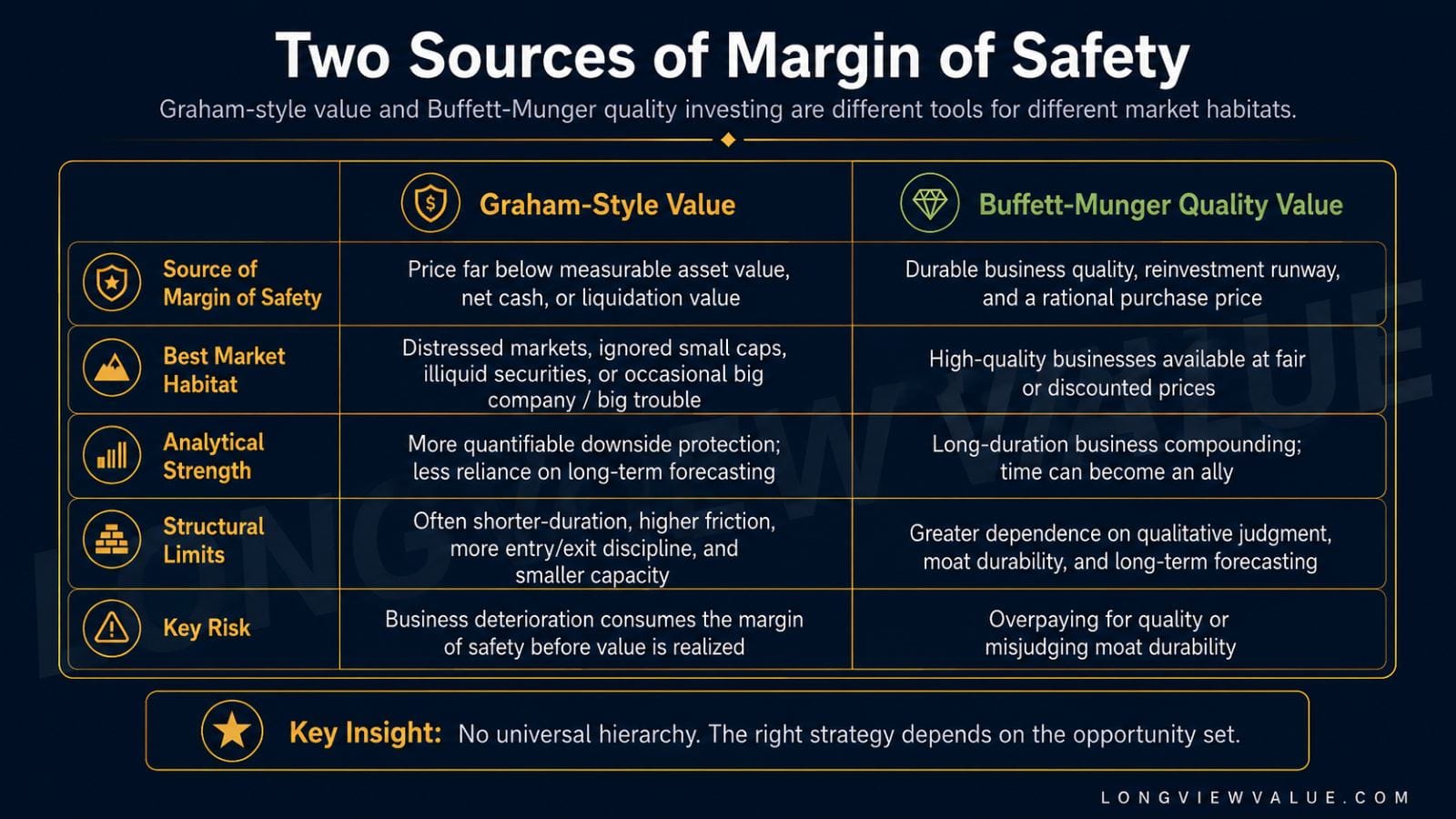
The mature investor does not ask which school is superior. He asks what form of margin of safety the market is offering — and what hidden costs, duration limits, and business risks are attached to that margin of safety.
A Three-Layer Framework for Long-Term Equity Ownership
Before turning to See’s Candies, it is useful to introduce a simple framework that will recur throughout LongViewValue’s company research.
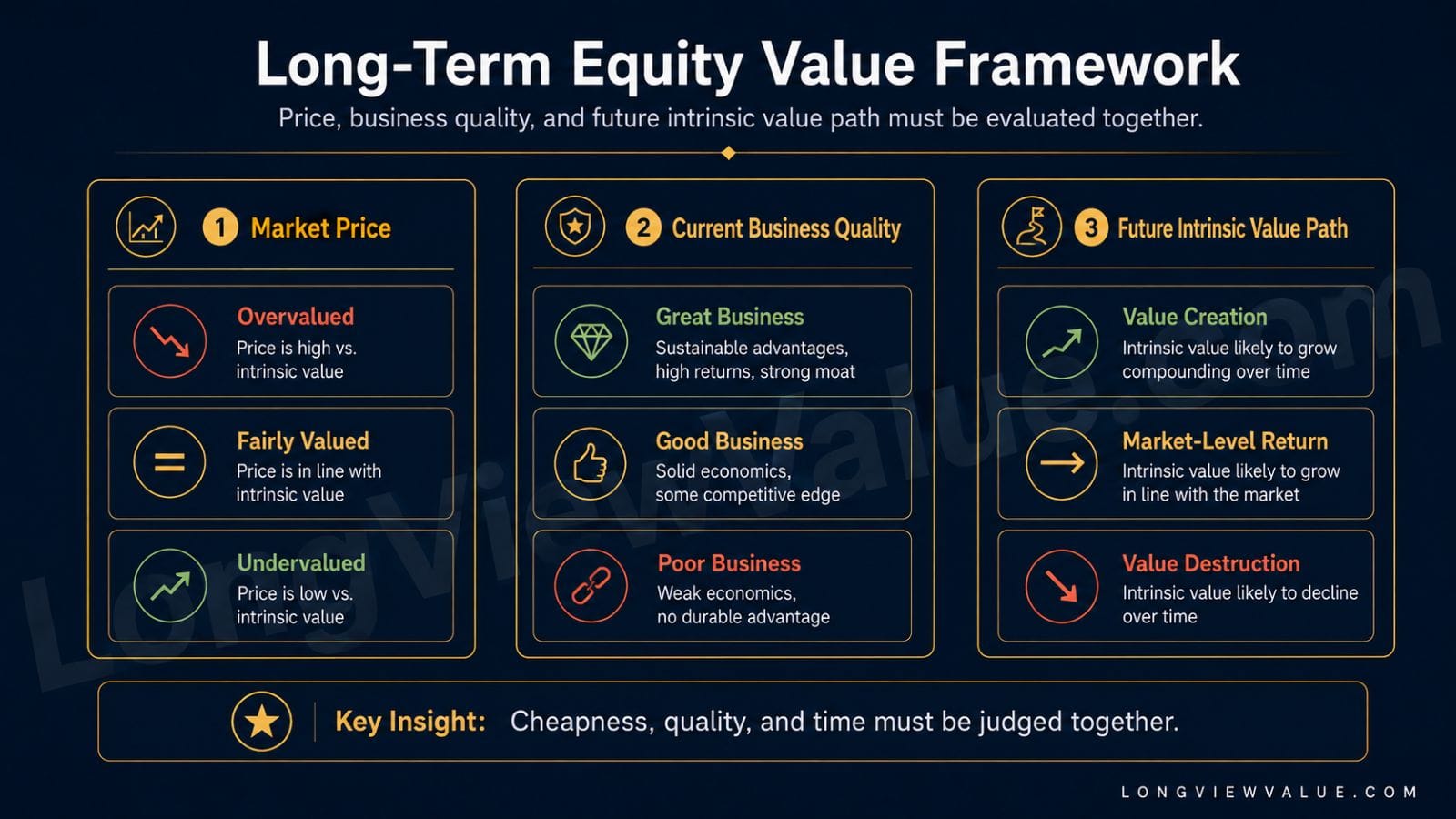
Every long-term equity investment requires three separate judgments:
- Market price
- Current business quality
- Future intrinsic value path
These judgments should be made separately and then combined.
Layer One: Market Price
The first question is whether the security is overvalued, fairly valued, or undervalued relative to conservative intrinsic value.
This is where Graham’s discipline is most visible. Without price discipline, even a good business can become a poor investment. The price paid determines the investor’s starting yield, implied expectations, and margin of safety.
A great business bought at a price that already assumes years of flawless execution may offer little protection. A merely good business purchased at a large discount may offer a better risk-reward if the discount is real and the business is not destroying value.
Layer Two: Current Business Quality
The second question is whether the company is a great business, a good business, or a poor business.
This is where Munger’s influence becomes essential. A low price may create a margin of safety at purchase, but business quality determines whether that margin can survive over time.
A poor business may erode asset value. A good business may preserve it. A great business may create new value.
The quality judgment requires understanding the business model, customers, returns on capital, reinvestment needs, competitive advantage, management behavior, and industry structure.
Layer Three: Future Intrinsic Value Path
The third question is whether the business is likely to create value, deliver market-level returns, or destroy value over the relevant holding period.
This layer separates a temporary bargain from a long-duration compounder. It also separates a cheap stock from a value trap.
A deeply undervalued asset may be attractive if value realization is possible within a reasonable period and the business is stable enough not to consume the discount. But if the business is deteriorating, the valuation gap may close in the wrong direction: not because the price rises, but because intrinsic value falls.
Combining the Three Layers
A Graham-style opportunity may involve a deeply undervalued price, acceptable or mediocre current business quality, and a future value path stable enough that the margin of safety is not destroyed.
A Buffett-Munger opportunity may involve a rational or undervalued price, great business quality, and a rising intrinsic value path.
A value trap may involve a cheap price, poor business quality, and declining intrinsic value.
See’s Candies fits the Buffett-Munger pattern: a reasonable price, a great business, and a future path of value creation.
Berkshire Hathaway’s textile business illustrates the opposite risk: a cheap price, weak business quality, and poor long-term economics.
The mature investor asks three questions together:
→ What price am I paying?
→ What quality of business am I buying?
→ What is the likely path of intrinsic value over time?
Only when these three layers are considered together can we distinguish a temporary bargain, a durable compounder, and a cheap-looking trap.
See’s Candies: The Turning Point from Cheap Assets to Great Businesses
See’s Candies is the clearest case study of the Buffett-Munger shift.
In 1972, Berkshire Hathaway acquired See’s Candies for $25 million. The business had tangible net assets of roughly $8 million, implying a price-to-tangible-book ratio of about 3.1 times. Pre-tax earnings were around $4 million, and returns on tangible capital were high.
From a strict Graham perspective, this was not an obvious bargain. It was not a net-net. It was not trading below liquidation value. It was not simply cheap relative to tangible book.
Buffett and Munger were paying for something the balance sheet did not fully capture.
What They Really Bought
They bought a trusted brand, customer loyalty, emotional purchasing habits, pricing power, predictable demand, and economic goodwill.
These assets were not fully visible on the balance sheet. But they determined future cash flow.
Economic goodwill is the bridge between accounting book value and intrinsic value. A business with genuine economic goodwill can earn high returns on tangible capital because its true assets are not only physical. They may include reputation, brand, customer trust, habit, distribution, and pricing power.
See’s made this visible. A business with modest tangible assets could generate strong earnings and raise prices without losing customers. Customers were not merely buying chocolate. They were buying trust, habit, and occasion.
Pricing Power and Customer Trust
A moat is not created by a slogan. It is built through repeated decisions that preserve customer trust.
A real moat is revealed not when conditions are easy, but when management refuses to damage customer trust under pressure.
See’s raised prices over time, but customers continued buying because the product carried emotional meaning and reliable quality. The brand had become part of a habit. That habit created pricing power. Pricing power created owner value.
Low Reinvestment and Owner Earnings
See’s also demonstrated the power of low reinvestment needs.
The business generated substantial cash over time while requiring relatively limited additional capital. That cash could be redeployed elsewhere within Berkshire.
This is central to owner earnings. Accounting profit is important, but a business is valuable because of the cash it can generate for owners after maintaining its competitive position. A capital-intensive business may report earnings while consuming most of them to remain competitive. A capital-light business with pricing power may produce cash that can be redeployed.
A great business does not only generate profits. It generates redeployable free cash flow.
See’s was not just an acquisition. It was a business education.
It helped clarify why a business can be worth far more than its tangible assets when it has durable customer advantage, pricing power, low capital intensity, and cash that can be rationally redeployed.
Mature Buffett: Price, Quality, and Time
The mature Buffett framework is not cheapness alone. It is not quality alone. It is not holding forever regardless of price.
It is the combination of price discipline, business quality, and time.
Price Still Matters
Buffett-Munger investing is not “buy great businesses at any price.”
The investor still needs conservative assumptions, rational entry price, expected return discipline, opportunity-cost awareness, and a margin of safety.
A wonderful business bought at an excessive price can still produce poor returns. The business may perform well while the investor’s return disappoints because too much future success was already priced in.
Quality changes the analysis, but it does not repeal valuation.
Quality Determines Whether Time Helps
Time is not automatically an investor’s friend.
For poor businesses, time reveals decay. Capital is consumed. Customers leave. Competitive position erodes. Industry structure worsens. The apparent discount may disappear because intrinsic value falls.
For great businesses, time allows value to compound. Brand trust deepens. Customer relationships accumulate. Reinvestment compounds. Management quality matters. Capital allocation creates value.
This is why the holding period differs across methods. In many Graham-style investments, the optimal holding period may be until the valuation gap closes. In a durable compounder, extending the holding period may improve the investment if the business continues to create value.
Owner Earnings and Capital Allocation
Owner earnings are central to the mature Buffett framework.
Accounting profit is not enough. The investor needs to know how much cash the business can generate for owners after maintaining its competitive position.
That cash then raises the capital allocation question: should it be reinvested, used for acquisitions, returned through buybacks or dividends, or held for future opportunity?
A great operating business can still disappoint if management allocates capital poorly. A business that generates cash but reinvests at low returns may destroy value. A business that uses excess cash to overpay for acquisitions may transfer value away from shareholders.
Business quality and capital allocation are therefore connected. Great economics create the opportunity. Capital allocation determines whether that opportunity is realized for owners.
Durable Moat
The mature Buffett framework also requires durable competitive advantage.
Moats can come from brand, network effects, switching costs, scale, cost advantage, distribution, customer habit, or other sources. The taxonomy is less important than the durability.
The investor must ask not only whether the business has an advantage today, but whether that advantage is likely to persist over the relevant holding period.
Quality matters because it changes the future intrinsic value path. A durable moat allows intrinsic value to rise. A fragile moat may give the illusion of quality before erosion becomes visible.
The mature Buffett framework brings price discipline, business quality, and time together. Putting it into practice requires the patience to wait for a sound opportunity and to remain invested while the underlying thesis holds.
Circle of Competence: The Boundary of Intelligent Investing
The more qualitative value investing becomes, the more important circle of competence becomes.
Graham could often begin with the balance sheet. A net-current-asset bargain may be analyzed with limited reliance on long-term business forecasting. But once the investor begins evaluating economic goodwill, moat durability, capital allocation, and long-term intrinsic value growth, the analytical burden rises.
That is why the Buffett-Munger expansion requires stricter boundaries, not looser ones.
Technology Was Not the Problem
During the internet bubble, Buffett avoided many technology stocks and was criticized for missing the future. But the lesson is often misunderstood.
Buffett did not avoid technology because it carried a technology label. He avoided businesses whose long-term economics he did not believe he could evaluate with sufficient confidence.
Buffett avoided what he could not understand, not what carried a technology label.
This distinction matters.
Value investing has no industry label. It is not defined by whether a company sells candy, insurance, software, semiconductors, or consumer products. It is defined by whether the investor can understand the business, estimate value, judge competitive advantage, analyze future cash flow, and buy with a margin of safety.
Bill Miller and the Absence of Industry Labels
Bill Miller offers a useful counterexample. As manager of Legg Mason Value Trust, Miller was widely regarded as a value investor, yet he was willing to analyze and invest in technology and internet companies such as Dell and Amazon when he believed the market was mispricing their long-term economics.
His logic was not “technology is growth, so buy it.” His logic was closer to this: a stock can appear optically expensive and still be undervalued if the market underestimates the durability, growth runway, or future cash-generating power of the business.
That is a value-investing argument.
Miller’s career also reminds us that expanding the circle of competence into technology does not eliminate risk. It raises the analytical burden. Technology businesses may face faster disruption, changing industry structures, and more uncertain terminal economics.
How value investors should approach emerging technology deserves a separate discussion. For now, the narrower point is simple: value investing has no industry label, but every industry demands its own circle of competence.
Knowing the Boundary
A circle of competence is not about knowing many things. It is about knowing boundaries.
We must understand what we understand, and what we do not understand.
That is not merely intellectual modesty. It is risk control.
Patient Capital: The Temperament Required to Let Value Compound
Even if the analysis is right, the investor still needs the temperament to let the investment work.
Patience is often misunderstood as inactivity. It is not. Patient investing involves reading, studying businesses, updating analysis, saying no, preserving optionality, and acting decisively when the opportunity is clear.
Most of the time, the patient investor is not doing nothing. He is preparing.
Cash, Optionality, and Decision Patience
Cash can be a strategic option. It allows investors to act when markets become irrational.
The point is not to prescribe a cash percentage. The point is that opportunity requires preparation — analytical preparation and financial optionality.
Decision patience matters as well. Buffett’s punch-card metaphor captures the idea: if investors had only a limited number of major investment decisions in a lifetime, they would likely become more careful.
The scarcity of decisions can improve the quality of decisions.
This runs against the culture of activity. More trades, more opinions, and more portfolio changes can look like diligence. Often they are noise.
Cognitive Patience
Compounding is back-loaded.
Early progress may look slow. Later results may look extraordinary. This is one reason long-term investing is psychologically difficult even when it is intellectually understood.
A strategy can be sound and still look wrong for years.
Berkshire Hathaway’s record illustrates this. Even an extraordinary long-term compounder experienced periods of underperformance, public criticism, and investor doubt.
In 1999, Barron’s ran a cover story asking “What’s Wrong, Warren?” Berkshire had underperformed during the technology boom. The market’s judgment, at that moment, was that Buffett had failed to adapt.
Then the internet bubble burst.
The lesson is not that Buffett was always right. The lesson is that long-term investing often looks wrong before it looks obvious.
Patient capital is not patience in words. It is the ability to remain rational when the strategy temporarily looks unfashionable.
What This Means for LongViewValue
LongViewValue’s research framework is built on this expanded understanding of value investing.
It does not reduce value investing to low multiples. It does not treat quality as an excuse to ignore price. It does not rank Graham and Buffett as low and high forms of intelligence.
It asks a more practical question:
What kind of value is being mispriced, and what form of margin of safety is most reliable here?
LongViewValue studies businesses through several linked dimensions:
- Margin of safety: What is the relationship between price and conservative value?
- Business quality: Does the business preserve or create value over time?
- Economic moat: What protects returns on capital, and how durable is that protection?
- Owner earnings: What cash can the business generate after maintaining its competitive position?
- Capital allocation: Does management redeploy cash in ways that create or destroy value?
- Market habitat: What type of opportunity is the market currently offering?
- Time: Is time an ally or an enemy in this investment?
Frameworks must be tested against real businesses. That is why company research matters.
Tencent is the first major LongViewValue case study not because it is simply “cheap” or simply “great,” but because it allows these frameworks to be tested against a real business with relationship infrastructure, switching costs, network effects, free cash flow, capital allocation decisions, valuation questions, and emerging AI optionality.
The purpose of company research is not only to evaluate one stock. It is to refine the toolkit. A careful study of one business should produce concepts that can be reused in the next business.
LongViewValue is not trying to choose Graham or Buffett. It is trying to understand when each source of value and margin of safety matters.
LongViewValue builds investment frameworks through deep company research and the study of value investing’s intellectual tradition.
Conclusion: Evolution Is Expansion, Not Replacement
The evolution from Graham to Buffett should not be read as a rejection of cheapness.
It should be read as an expansion of the value investor’s toolkit.
Graham taught investors how to survive uncertainty through price discipline and margin of safety. Buffett learned that discipline first. Munger helped Buffett see that business quality could change the time horizon of investing. See’s Candies demonstrated that intangible assets, pricing power, and owner earnings could be far more valuable than tangible book value suggested.
Mature Buffett combined price, quality, and time.
But none of this makes Graham irrelevant.
There are markets where cheap assets are the better opportunity. There are markets where durable businesses at rational prices are the better opportunity. There are also situations where both approaches can fail: cheap assets can become value traps; great businesses can be overpaid for; circle of competence can be violated; patience can be tested; market habitat can change.
The mature value investor should not ask: Which school is superior?
The mature value investor should ask: What kind of opportunity is the market offering, and what form of margin of safety is most reliable here?
Value investing began with the discipline of not overpaying.
It matured into the discipline of understanding what is worth owning.
But its deepest lesson may be this: no method is superior outside the market habitat where it can actually work.
Disclaimer
This article is for informational and educational purposes only. It does not constitute investment advice, a recommendation, or a solicitation to buy or sell any security. All investing involves risk, including the risk of permanent capital loss. Readers should conduct their own research and consult appropriate professional advisers before making investment decisions.